


Best Electric Hunting Bikes for Deer Hunting: Whitetail & Mule Deer
Deer hunting and elk hunting are different sports, and they demand different bikes. But even within deer hunting, there is a massive divide: a whitetail hunter sneaking to a treestand in Iowa timber has completely different needs than a mule deer hunter covering miles of sagebrush and coulees in Montana.
This guide covers both. We will recommend specific bikes for each, explain why, and share what hunters in the field are actually experiencing.
Updated March 2026. All bikes listed are current models available at ebikegeneration.com.
Two Hunts, Two Sets of Demands
| Whitetail | Mule Deer | |
|---|---|---|
| Terrain | Flat to rolling — timber, fields, food plots, creek bottoms | Steep hills, sagebrush flats, coulees, canyon country |
| Typical distance | 0.5 – 3 miles from truck to stand | 3 – 15 miles from truck to glassing points |
| Elevation gain | Minimal (0 – 500 ft) | Significant (1,000 – 3,000 ft) |
| Hunting method | Treestand, blind, food plot ambush | Spot-and-stalk, glassing, still-hunting |
| #1 priority | Silence and scent control | Range and climbing power |
| Pack-out weight | 100 – 200 lbs (whole or quartered) | 100 – 200 lbs (bone-in quartered) |
| Season temps | 30 – 70°F (varies widely by state) | 15 – 50°F (mountain West, Oct-Nov) |
| Trail surface | ATV trails, field edges, logging roads, two-track | Forest roads, rocky two-track, sagebrush, no trail |
Part 1: Best eBikes for Whitetail Hunting
Whitetail hunting is a stealth game. You are not trying to cover 15 miles of backcountry — you are trying to get to your treestand, ground blind, or food plot edge without the deer knowing you exist. The three things that blow a whitetail setup are noise, scent, and visual disturbance. The right ebike addresses all three.
Why eBikes Are a Game Changer for Whitetail
Scent Control
This is the advantage whitetail hunters talk about most. An ebike gets you to your stand without the two biggest scent problems: sweat and ground scent.
As one hunter on Habitat Talk explained: "It decreases ground scent. Theoretically, it also minimizes how much wind-based scent carries, because you're spending less time along that entry or exit route."
Think about a half-mile walk to your treestand on a 55-degree October evening. By the time you climb up, you are sweating. That scent plume is now drifting downwind through the exact area you are hunting. On an ebike, you roll in with pedal assist, your feet barely touch the ground, and you are in the stand dry and scent-free in a fraction of the time.
Deer & Deer Hunting put it simply: "Besides saving your legs, this also means arriving at stands fresher — not overheated and sweaty as is so often the case when hiking into distant stands."
One practical caveat from the same Habitat Talk thread: "The advantages are less exertion and thus less scent being created — less, not zero. The bike does have grease and the like in it that deer can smell." Keep your bike clean and store it away from fuel and chemicals.
Silence
A hunter on Archery Talk described the experience: "Completely silent — it feels like flying like a bird through the forest." The same hunter reported "seeing noticeably more deer this year than in prior years using an ebike."
Compare that to the sound of an ATV, which deer can hear from a quarter mile. Or even the rhythmic crunch of boots on frozen leaves. An ebike on pedal assist produces a soft hum that is effectively inaudible beyond 50 yards.
Speed and Efficiency
A hunter on Accurate Shooter Forum with 7 years of ebike experience said he "wouldn't go back to an ATV even if they were legal" — noting "the bike is easier to transport and much stealthier and will pull out a deer with carts designed for them."
Beyond treestand access, whitetail hunters use ebikes for scouting, checking trail cameras, making mock scrapes, and managing food plots. As onX Hunt pointed out: "Searching a five, 10, or 15-acre food plot may take a couple of hours by foot, but with an e-bike you can zig-zag over the ground more efficiently." They also noted ebikes offer "an advantage over ATVs when ground is wet and you don't want to damage it."
Best eBikes for Whitetail
#1. BAKCOU Flatlander SD — Built for Whitetail Country

| Price | $3,699 |
| Motor | Bafang 750W dual-speed internal hub, 85 Nm |
| Battery | 52V 20Ah (1,040 Wh) — dual to 40Ah (2,080 Wh) |
| Range | 40+ miles single / 80-100+ miles dual |
| Drivetrain | Single-speed with dual-speed internal hub — NO derailleur |
| Brakes | Tektro HD E725 quad-piston, 203mm |
| Tires | CST 26" or 24" x 4.0" |
| Weight | ~67 lbs (without battery) |
| Load Capacity | 350 lbs |
The name says it — Flatlander. BAKCOU designed this bike specifically for the terrain whitetail hunters face: fields, timber, food plot edges, creek bottoms, and ATV trails. The hub motor is whisper-quiet. The internal dual-speed gearing means there is no external derailleur to snag on brush, clog with mud, or break in the field. The 52V SD platform supports dual battery for 80-100+ miles — more range than any whitetail hunter needs in a season, let alone a day.
Why it is ideal for whitetail:
- Quietest option in the lineup — hub motors produce less noise than mid-drives. No chain-on-cassette noise from the motor.
- Zero-maintenance drivetrain — no derailleur to adjust, no cassette to replace, no chain-drop. Ride through cornfield stubble, tall grass, and creek crossings without worry.
- BAKCOU Connect GPS — mark stand locations, camera sites, entry/exit routes. Plan your approach based on wind direction.
- 67 lbs without battery — lightest bike in the BAKCOU lineup. Easy to load on a truck rack.
→ Shop the BAKCOU Flatlander SD
#2. Rambo Rebel 2.0 — Quiet Mid-Drive for Timber Hunters
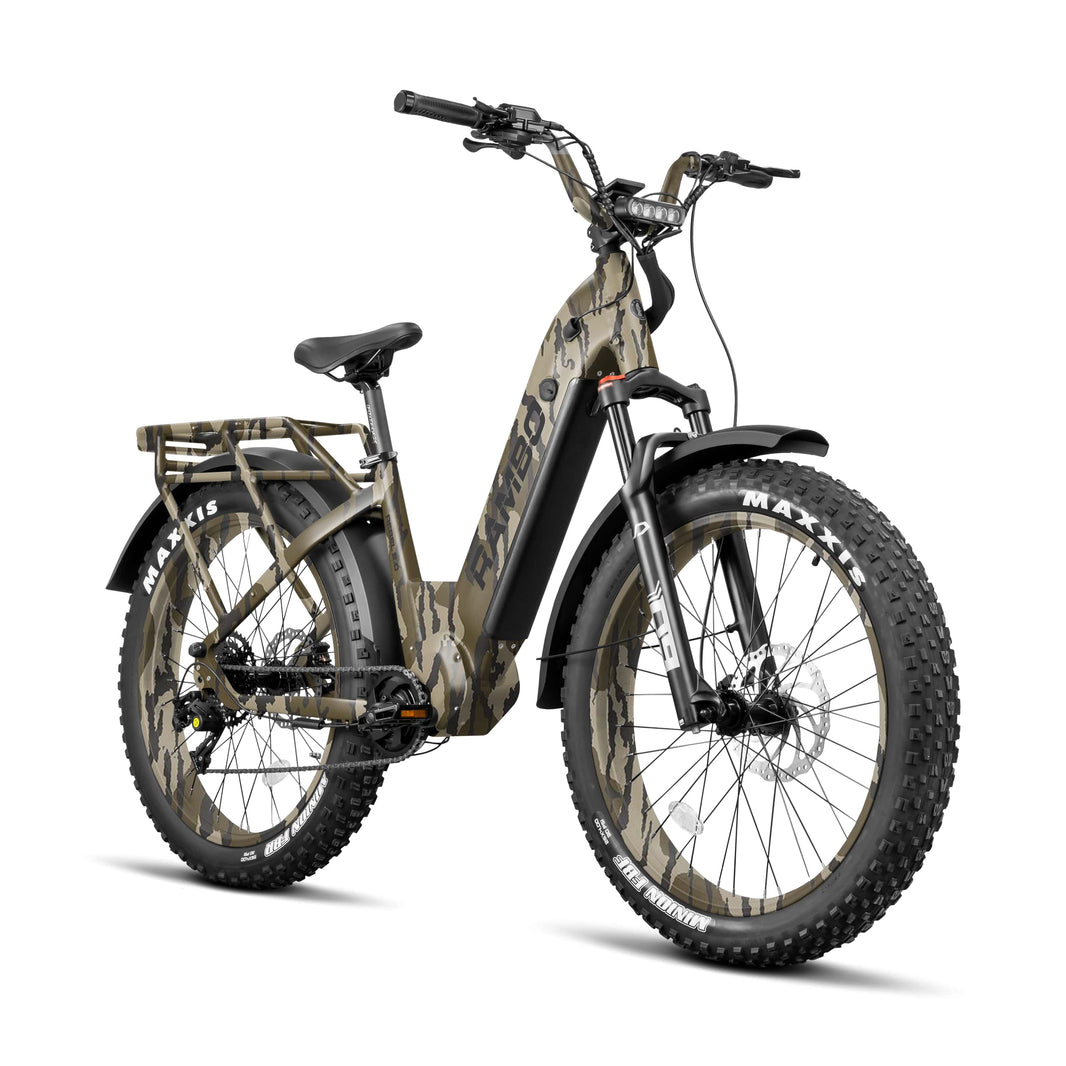
| Price | $3,299 |
| Motor | Bafang BBSHD mid-drive, 1000W / 1632W peak, 160 Nm |
| Battery | 48V 15Ah or 20Ah (dual 14Ah option) |
| Range | 48 miles (15Ah) / 65 miles (20Ah) |
| Drivetrain | Box 8-speed (11-42T) or single-speed |
| Brakes | Rambo Heavy-Duty 4-piston, 203/180mm |
| Tires | Maxxis Minion 26" x 4.0" |
| Weight | 80 lbs (without battery) |
| Load Capacity | 300 lbs |
| Colors | OD Green, Mossy Oak Bottomland |
The Rebel 2.0 uses the Bafang BBSHD — which Rambo markets as "Bafang's quietest high-torque motor." From our experience, that claim is accurate. For whitetail hunters who need more power than a hub motor (hilly timber, creek crossings with loaded trailer) but still prioritize a quiet approach, the Rebel threads the needle.
The Mossy Oak Bottomland camo option is purpose-built for hardwood timber. The Maxxis Minion fat tires grip wet leaves, frozen ground, and muddy field edges. And at $3,299, it undercuts both the Flatlander SD and the BAKCOU mid-drive lineup by a significant margin.
The Rebel 2.0 SS (single speed) removes the derailleur entirely — same frame, same motor, same brakes, zero drivetrain maintenance. If your whitetail property is moderate terrain (no steep climbs requiring gear changes), the SS is the simpler, more reliable choice.
→ Shop the Rambo Rebel 2.0 | → Shop the Rebel 2.0 SS
#3. Rambo Krusader 3.0 AWD — Mud, Snow, and Budget

| Price | $2,969 |
| Motor | Dual Bafang 500W hub motors, 1500W peak, 140 Nm |
| Battery | 48V 15Ah or 20Ah (dual 14Ah option) |
| Range | 48 miles (15Ah) / 65 miles (20Ah) |
| Drivetrain | Single-speed or Shimano 8-speed |
| Brakes | Rambo Heavy-Duty 4-piston, 203/180mm |
| Tires | Kenda 24" x 4.0" anti-puncture |
| Weight | 78 lbs (without battery) |
| Load Capacity | 300 lbs |
If you hunt late-season whitetail in the Midwest, you know mud and snow. The Krusader 3.0 gets you AWD traction for under $3,000 — nothing else in the market touches that. The step-through frame makes it easy to mount and dismount in heavy gear. The single-speed option eliminates the derailleur for hunters who ride through cornfields, CRP grass, and frozen creek bottoms where derailleurs get destroyed.
This is not a mountain bike. It is a purpose-built machine for getting to your stand, hauling your deer out, and not breaking the bank doing it.
→ Shop the Rambo Krusader 3.0 AWD
#4. Rambo Megatron 4.0 AWD — Maximum Traction

| Price | $3,849 |
| Motor | Dual Bafang 1000W hub motors, 2500W peak, 180 Nm |
| Battery | 48V 20Ah or 30Ah (dual 14Ah option) |
| Range | 65 miles (20Ah) / 97 miles (30Ah) |
| Tires | Kenda 26" x 4.8" anti-puncture |
| Weight | 89 lbs (without battery) |
| Load Capacity | 350 lbs |
| Colors | FDE, TrueTimber Viper Western |
The Megatron 4.0 is Rambo's most powerful AWD bike — 2,500W peak power, switchable FWD/RWD/AWD, and the widest tires (4.8") in any hunting ebike lineup. For late-season whitetail in snow, mud, or sandy river bottoms, the traction advantage is real. The TrueTimber Viper Western camo is purpose-designed for western and transitional terrain.
Run it in RWD for normal riding and switch to AWD when conditions demand it. The 30Ah battery option gives you nearly 100 miles of range — enough for an entire season of daily treestand commutes without recharging.
→ Shop the Rambo Megatron 4.0 AWD
Part 2: Best eBikes for Mule Deer Hunting
Mule deer hunting is a western pursuit. You are covering miles, climbing ridges, glassing from high points, and spot-and-stalking across open terrain. The demands overlap significantly with elk hunting — steep terrain, long distances, cold temperatures — but with some key differences.
Mule deer are typically smaller than elk (field-dressed bucks run 125-200 lbs vs 400-700 lbs for elk), so pack-out weight is more manageable. But the distances and terrain can be just as demanding. Many mule deer units are on BLM and National Forest land with motorized restrictions, making trail-legal compliance more important.
What Mule Deer Country Demands
- Range: 5-15 miles from truck to hunting area — same as elk
- Climbing: 1,000-3,000 feet of elevation gain is common in Colorado, Montana, Wyoming, and Idaho mule deer units
- Motor type: Mid-drive strongly preferred. As Grand View Outdoors advised: "For hunters chasing game in the hills, those with a mid-drive motor are preferred over hub-drive motors." And: "If you spend all of your time in mountain terrain, a 1,000-watt unit is justified."
- Trail surface: Rocky two-track, sagebrush, forest roads — fat tires (4"+) required
- Public land compliance: Many units restrict motorized access. Class 1 (750W, pedal-assist only) may be required.
Best eBikes for Mule Deer
#1. BAKCOU Mule SD — The Western Standard

Everything we said about the Mule SD for elk applies to mule deer. The 160 Nm mid-drive climbs anything rideable. The dual battery system (100+ miles) handles full days of glassing, stalking, and retrieving. The 350 lb capacity carries rider, gear, and a quartered mule deer buck in a single trip with a trailer.
At $5,599, it is a serious investment. But for western hunters who chase mule deer and elk on the same property, the Mule SD is one bike for both seasons.
#2. Rambo Rebel 2.0 — Best Value for Western Deer

The Rebel 2.0 at $3,299 gives you a 1000W mid-drive with 160 Nm torque, Maxxis Minion tires, and 4-piston brakes — the core components you need for mountain terrain. You sacrifice the 52V SD ecosystem, GPS tracking, and dual battery system compared to the Mule SD. But you save $2,300.
For mule deer specifically, the Rebel's 65-mile range (20Ah battery) is often sufficient. Mule deer pack-outs are lighter than elk — a 175 lb field-dressed buck quartered into a trailer is a single-trip job on moderate terrain.
#3. BAKCOU Scout — Full Suspension for Rough Country

If your mule deer country is rocky, rooted, and rough — think Idaho canyon breaks, Montana coulees, or Colorado oakbrush — the Scout's full suspension with RockShox Monarch rear shock saves your body over 10+ mile days. Same M620 motor and 160 Nm torque as the Mule SD, at $800 less.
#4. Rambo Roamer 2.0 — Public Land Legal

Many prime mule deer units on National Forest and BLM land restrict motorized access. The Roamer 2.0's 750W mid-drive with Box 8-speed is positioned for Class 1 compliance — pedal-assist only, 750W max, 20 mph — allowing access to trails where 1000W bikes would be illegal.
For public land mule deer hunters, legal access is more valuable than raw power. The Roamer 2.0 gets you there legally.
Quick Comparison: Whitetail vs Mule Deer eBike Picks
| Bike | Price | Best For | Motor | Why |
|---|---|---|---|---|
| Flatlander SD | $3,699 | Whitetail | 750W hub | Quietest. No derailleur. Built for flat/rolling terrain. |
| Rebel 2.0 | $3,299 | Both | 1000W BBSHD | Quiet mid-drive. Climbs and flatlands. Best value. |
| Rebel 2.0 SS | $3,299 | Whitetail | 1000W BBSHD | No derailleur. Brush, mud, cornfield proof. |
| Krusader 3.0 | $2,969 | Whitetail | Dual 500W hub | Budget AWD. Mud and snow. |
| Megatron 4.0 | $3,849 | Whitetail | Dual 1000W hub | Max AWD power. 4.8" tires. Late season. |
| Mule SD | $5,599 | Mule deer | 1000W M620 | Mountain climbing. Dual battery 100+ mi. 350 lb capacity. |
| Scout | $4,799 | Mule deer | 1000W M620 | Full suspension for rocky terrain. |
| Roamer 2.0 | New 2026 | Mule deer | 750W mid-drive | Public land legal (Class 1). |
The Science of Scent and Sound: Why eBikes Work for Deer
Scent Reduction
Three mechanisms reduce your scent profile on an ebike vs walking:
- Less sweat. Pedal assist means you exert a fraction of the effort of hiking with a pack. Less exertion = less perspiration = less scent production.
- Less ground contact. Your feet are on pedals, not the ground. You leave fewer scent molecules along your entry route.
- Less time. You spend half or a third as long on the entry route compared to walking, reducing the total scent you deposit along the path.
None of this makes you invisible to a whitetail's nose. Wind direction still matters. But reducing your scent signature by even 50% on the approach can be the difference between a deer that stays in range and one that blows out at 200 yards.
Noise Comparison
| Approach Method | Noise Level | Detection Distance (quiet woods) |
|---|---|---|
| ATV | 75-100 dB | 1/4 to 1 mile |
| Walking (leaves/frozen ground) | 40-60 dB | 100-300 yards |
| eBike (pedal assist) | 20-35 dB | 50-150 feet |
An ebike on pedal assist is quieter than walking. The soft hum of the motor is masked by even a light breeze. Tire noise on packed ground or gravel is the loudest component — and it is still less than the crunch of boots on dry leaves.
Getting Your Deer Out
A whitetail buck field-dresses at 125-175 lbs. A mule deer buck, 150-225 lbs. Both are manageable on a game trailer.
The Rambo Bike/Hand Cart (300 lb capacity) handles a whole field-dressed whitetail in one trip on moderate terrain. For quartered mule deer bucks on steep two-track, a two-trip approach is safer — two quarters per trip plus the backstraps and head/cape on the second run.
BAKCOU's Folding Deer Trailer and Folding Cargo Trailer are designed for this exact use case — fold flat for the ride in, unfold for the pack-out.
Frequently Asked Questions
Will an ebike spook deer on my property?
Less than an ATV or even walking. Whitetail respond to noise, scent, and visual disruption. An ebike on pedal assist is quieter than footsteps on dry leaves and produces far less scent than a sweating hunter. That said, riding directly past a bedded buck at 20 yards will spook it regardless of the vehicle. Plan your entry routes to avoid known bedding areas, just as you would on foot.
Do I need AWD for whitetail hunting?
Only if your terrain includes deep mud, snow, or sand. For dry timber, food plot edges, and ATV trails, a single-motor bike (hub or mid-drive) handles everything. AWD adds weight and cost. The Krusader 3.0 ($2,969) or Megatron 4.0 ($3,849) are worth it if you regularly face those conditions. Otherwise, save the money and weight.
Do I need a mid-drive for whitetail?
Not necessarily. If your property is flat to gently rolling — most Midwest and Southeast whitetail properties — a hub motor like the Flatlander SD is quieter and has fewer maintenance needs. If your property has significant hills (Appalachian whitetail, Ozarks, bluff country), a mid-drive like the Rebel 2.0 gives you the climbing torque a hub motor lacks.
What about mule deer on public land — do I need a 750W bike?
Check your specific unit's regulations. Many National Forest trails allow Class 1 ebikes (750W, pedal-assist only, 20 mph max) where mountain bikes are permitted. If your access route is on a motorized-designated road (shown on the MVUM), wattage restrictions typically do not apply. The Rambo Roamer 2.0 (750W) is the safest choice for uncertain regulatory situations. BAKCOU bikes with On-Demand Programming can also be configured as Class 1.
Can I carry a treestand on my ebike?
Yes. Hang-on stands (15-20 lbs) and climbing stands (20-30 lbs) strap to a rear rack or pannier bags. Saddle hunting kits (5-10 lbs) are easily carried in a daypack. For hub-style ground blinds (15-25 lbs), strap to the rear rack or a trailer.
How do I keep my bike hidden at the stand?
Most whitetail hunters lay the bike down in brush or tall grass within 50-100 yards of the stand. The camo color options (Mossy Oak Bottomland on the Rebel, OD Green on multiple models) help. Some hunters drape a camo net over the bike. The key is parking downwind of your expected deer movement — same wind discipline you apply to everything else in whitetail hunting.
Need Help Choosing?
Call us at (302) 343-3950. Tell us whether you are hunting whitetail or mule deer (or both), describe your terrain, and we will match you to the right bike. We sell and ride both BAKCOU and Rambo — no brand loyalty, just honest recommendations.
→ Shop BAKCOU | → Shop Rambo | → Shop All Hunting eBikes
Related Reading
- Best Electric Hunting Bikes for 2026
- Best Electric Hunting Bikes for Elk Hunting
- BAKCOU vs Rambo: Which Hunting eBike Brand is Right for You?
- Electric Hunting Bike Drivetrains Explained: The Complete Guide
- Electric Bike vs ATV for Hunting: An Honest Comparison
This article was last updated in March 2026. Prices and specs are subject to change.